This translation is machine-generated and pending review.
Python is a general-purpose interpreted programming language, very popular and able to be used to develop a wide variety of applications. It has high-level data structures, modules, exceptions, dynamic typing, dynamic binding and many features.
The language can also be extended to make direct system calls to almost every operating system, and it can also run code written in C or C++. Thanks to its ubiquity and its ability to run on nearly every system architecture, Python is a universal language found in many popular programs.
It has thousands of third-party modules available in the Python Package Index ( PyPI ). PyPI provides popular standards for different fields, such as Django for web development and NumPy, Pandas and Mathplotlib for data science.
A Brief History of Python
Python was created in the late 1980s, and its implementation began in December 1989 by Guido van Rossum at CWI in the Netherlands.
Python version 2 was released on October 16, 2000, with many important new features, including a garbage collector with cycle detection for efficient memory management and Unicode support. However, the main change was in the development process itself, adopting a more transparent, more collaborative and community-backed process.
Version 3 was released on December 3, 2008 and is still the main version today. It brought major changes that made it incompatible with previous versions. Many of its key features were also adapted for the backward-compatible Python 2.6 and 2.7 to try to minimize the impact on older applications.
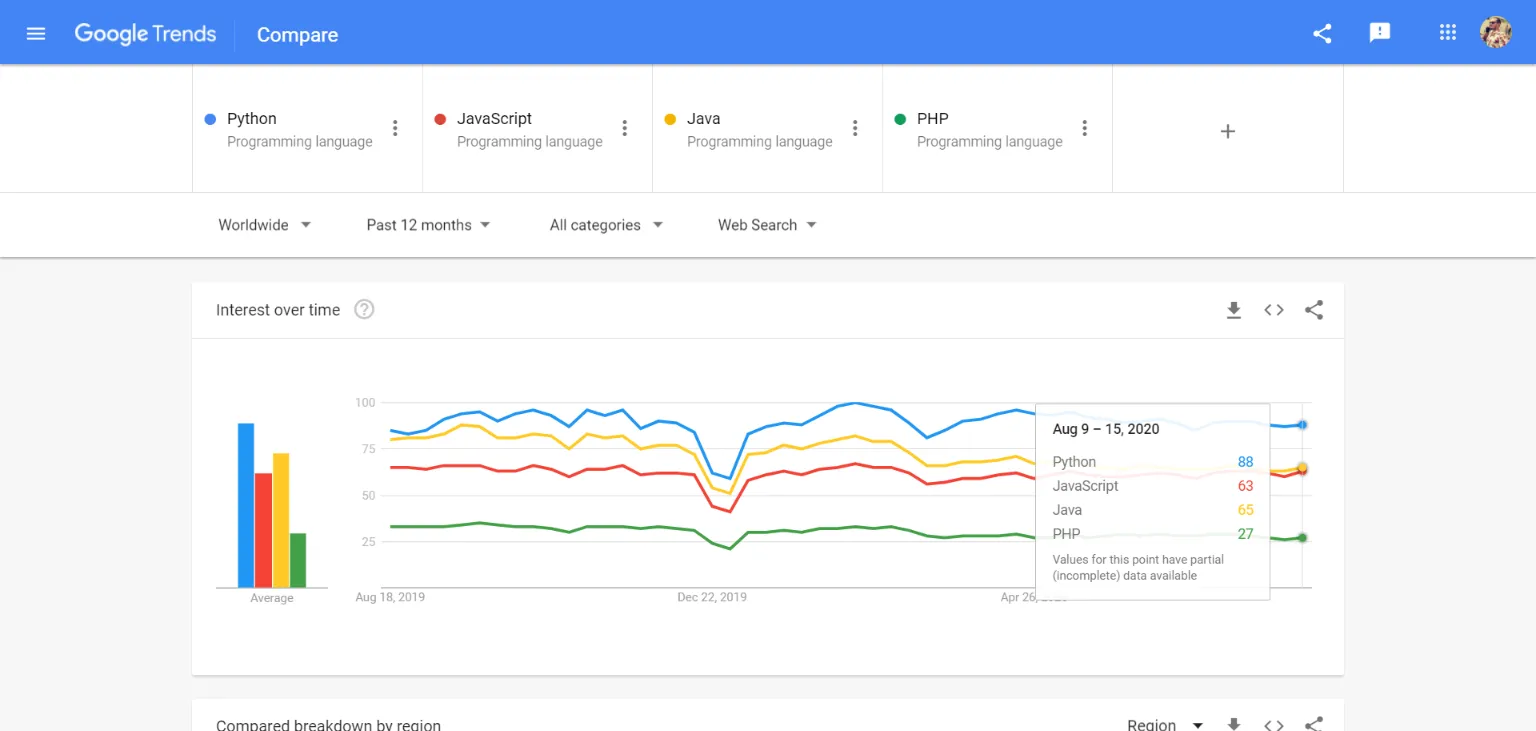
Google Search Interest by Programming Language
Recently Python has regained popularity due to the growth of sectors like Data Science, Artificial Intelligence and Big Data. Because it has several libraries specific to these applications, it came back into the spotlight, becoming one of the most popular programming languages today.
Is Python open source?
Yes, all modern versions of Python are copyrighted under a GPL-compatible license certified by the Open Source Initiative. Python’s source code is available on its own website.
Advantages of Python
Python is a programming language that is very easy to read and has a simple syntax to learn. Its code style guidelines provide a set of rules to make the code easier to format and maintain.
Because it is an interpreted language with a low learning curve, it becomes an agile tool for software development, able to produce a lot in a short time. It also has a huge community, with plenty of materials available across the internet and many users willing to help.
See below a simple example of code written in python:
What is Python used for?
Python can be used to develop several types of systems and applications. Below we will look at some of the most popular uses for the language.
Web Development
Python is widely used on the backend of websites and web systems. Thanks to the popularity of large frameworks like Django and Flesk it is now possible to create complex, optimized web systems. Major sites like Instagram, Spotify and Reddit are examples of successful web development using python.
Data Science
Python is widely used for scientific research and computing, because it has several scientific libraries specific to this use, including:
-
atropy for astronomy.
-
biopython for biology and bioinformatics.
-
numpy is a fundamental package for scientific computing with Python.
-
scipy complements the popular Numpy module, focused on mathematics, science and engineering.
-
pandas provides high-performance, easy-to-use data structures and data analysis tools.
And much, much more… Python’s role in data analysis is definitely a great advantage of learning it. Thanks to the exponential growth of this sector, Python developers are more in demand than ever.
Machine Learning
Machine Learning is the new trend in the technology world. Its popularity has been steadily growing due to its lower cost and its seemingly unlimited application possibilities.
The idea that computers can actively learn instead of operating only on what was coded is fascinating. This technology offers a completely new approach to problem solving, and at the forefront of machine learning is Python.
Internet of Things (IoT)
The Internet of Things can have several different definitions; here we are talking about physical objects, a refrigerator, for example, connected to an embedded system that links them to the internet.
IoT projects often involve real-time analysis and processes; ideally, your programming language should be lightweight, performant and scalable, the ideal use for Python.
Who uses Python?
Several programs and companies are fond of Python.
- Instagram uses Python on its backend.
- Google uses Python whenever possible - “Python where we can, C++ where we must”.
- Netflix makes extensive use of Python in its systems.
- Mozilla, best known for its Firefox browser, claims to have more than 230 thousand lines of code written in Python.
- Uber uses Jupyter Notebook and IPython for data analysis.
- Dropbox has been a public advocate of Python 3 in its infrastructure.
- Slack, Digital Ocean, Lyft, Sauce Labs and Fastly are companies that widely publicize their use of Python.
- Many companies in the financial market, like Bloomberg and JPMorgan.
In addition, many IT infrastructure technologies and low-level operating system programs are written in Python. It is also present in several desktop programs. Python can be used for practically anything!
Conclusion
Python is a very powerful and versatile language, but at the same time easy to learn. Thanks to its wide variety of applications, it becomes a perfect language for anyone looking to break into the world of development.